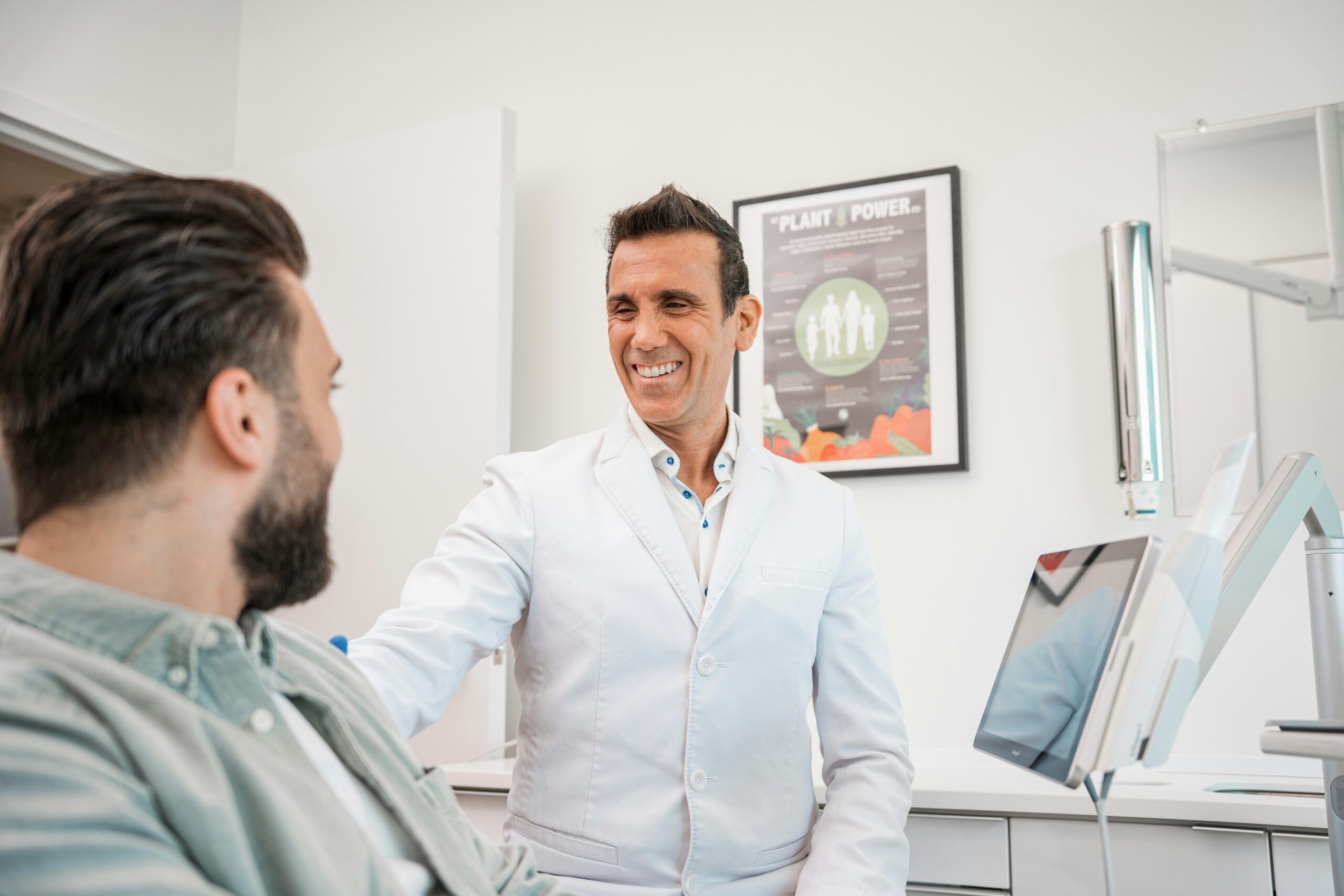
A practical guide to building trust, answering patient questions, and turning your website into a stronger patient-acquisition tool.
A prospective patient can learn a surprising amount about your practice before anyone on your team says a word.
In a few minutes on your website, they’ll scan your Google reviews, check your social accounts, compare your services, and decide whether your office feels like somewhere they’d trust with their care.
They’re not just weighing credentials or prices. They’re asking more personal questions:
- Does this dentist seem approachable?
- Will the team make me feel comfortable?
- Is the office clean and modern?
- Does the practice understand my specific concern?
- What will the visit actually be like?
Video answers those questions in a way copy and stock photography can’t. Patients see your office, hear your voice, meet your team, and get a real sense of what sets your practice apart. One polished promotional video won’t cover all of that on its own — the most effective dental practice video marketing uses several videos, each answering a different question, to reduce uncertainty, build familiarity, and give patients enough confidence to book.
Here are six dental practice videos every website should have.
Table of Contents
1. The Dental Practice Overview Video
A practice overview video is the closest thing your website has to a face-to-face introduction.
It should give prospective patients a clear picture of who you are, what you believe, and what to expect. Depending on your brand, that might mean showing your doctors and team, the office itself, how you approach patient care, the services you’re known for, your technology, patient amenities, or your ties to the local community.
Keep the scope narrow. Trying to cover implants, veneers, orthodontics, preventive care, financing, technology, and practice history in one video usually produces something rushed and unfocused.
Treat the overview as your primary brand video instead, one built to communicate the overall feeling of your practice. Are you a relaxed family office where patients are known by name, or a technology-forward practice built for complex cases? A cosmetic practice focused on personalized care, or a growing group delivering a consistent experience across locations? The overview should make that identity clear.
For many patients, this is the first video of yours they’ll watch. Keep it focused and personal. When it works, viewers finish it feeling like they already know your practice a little.
A dental practice video built around a clear, consistent identity, the kind of first impression that keeps a prospective patient browsing instead of clicking away.
2. The Doctor Introduction Video
Once a patient has a feel for the practice, their next question is usually who’s actually going to treat them.
A doctor introduction video builds that familiarity before the first appointment. Credentials matter, especially for a complex or high-value procedure, but a list of degrees and certifications only tells part of the story. Patients also want to know whether the dentist is kind, honest, patient, and easy to talk to.
A strong doctor video usually touches on their education and experience, why they chose dentistry, how they think about patient care, how they explain treatment options, how they handle dental anxiety, the procedures they care most about, and what draws them to the community they serve.
The best of these don’t sound like a résumé read aloud. They sound like a real conversation. Patients will forget the year a dentist graduated long before they forget whether that dentist seemed warm and sincere.
This matters even more for multi-doctor and multi-location practices, where a dedicated introduction for each provider helps patients find someone whose personality or clinical focus actually fits what they need. The same footage can also be cut down for provider pages, social media, YouTube, recruiting, and your Google Business Profile. A strong doctor introduction is one of the highest-value dental practice video investments a multi-provider practice can make.
3. The Dental Office Tour Video
Your team knows the office by heart. A new patient doesn’t, and that unfamiliarity creates real hesitation, especially for someone with dental anxiety, a parent choosing a pediatric dentist, or a patient facing a bigger procedure.
An office tour video makes the experience predictable. Rather than a quick montage of empty rooms, walk the viewer through what a visit actually feels like: the entrance, check-in, consultation rooms, treatment rooms, your technology, sterilization, comfort amenities, how your team interacts with patients, accessibility, and any spaces built for kids or families.
Photography still matters here — patients want images they can scan quickly. Video adds the parts a photo can’t: a team member greeting a patient, an explanation of how check-in works, the small moments that make a space feel less intimidating.
This doesn’t need to look like a real estate walkthrough. It needs to feel accurate and consistent with what patients will actually experience when they arrive. A real office, shown honestly, does more for trust than one staged to look flawless. Even a simple, honest office tour counts as a genuinely useful dental practice video.
A real walkthrough of the office and what a visit actually feels like, the kind of familiarity that eases anxiety before a patient ever walks in.
4. Patient Testimonial Videos
After seeing the office, most prospective patients look for proof that someone else had a good experience there. That’s what testimonial videos provide.
A strong testimonial is more than a patient saying the staff was great. That’s a nice compliment, but it doesn’t give a viewer much to hold onto. A useful testimonial covers what the patient was dealing with before treatment, why they chose your practice, what the experience was actually like, what result they got, and how that result changed their day-to-day life or confidence.
That structure gives viewers something specific to relate to, which matters most for treatments that ask for a real financial or emotional commitment: implants, cosmetic work, veneers, Invisalign, full-mouth rehabilitation, sedation dentistry, complex restorative care, or treatment for anxious patients.
Patients should sound like themselves, not actors reading ad copy. A good production team knows how to guide the conversation with the right questions while letting the patient’s real personality carry the video. Get consent handled properly before you record or publish, especially with anything involving treatment details or before-and-after content.
Done right, a testimonial gives a prospective patient a credible picture of both the clinical outcome and what it actually felt like to go through it.
A dental practice video testimonial that goes past ‘the staff was great’ and gets into what treatment actually changed, the kind of detail that gives other prospective patients something to relate to.
5. Service-Specific Dental Videos
A general practice video introduces the practice as a whole. A service-specific video helps someone decide whether one particular treatment is right for them, which makes it useful on treatment pages for things like implants, veneers, Invisalign, sedation dentistry, emergency care, pediatric dentistry, full-mouth reconstruction, same-day crowns, or smile makeovers.
Skip the clinical lecture. Most patients don’t need a rundown of every material or step — they need answers to what’s actually influencing their decision. Am I a candidate? What problem does this solve? What’s the process like? Does it hurt? How long is recovery? What do people usually get wrong about this treatment? What makes your approach different?
These videos also make a dental website more useful, because they answer the exact questions people type into Google or ask an AI tool — things like “how do dental implants work” or “what should I expect after full-mouth reconstruction.” A focused video, paired with a page that includes a transcript, captions, and clear headings, gives both patients and search platforms something concrete to work with.
One good interview can also become several pieces of content. A single implant conversation might turn into separate clips on candidacy, recovery, bone grafting, timelines, and common fears, giving you a library for your site, YouTube, social, email, and paid ads instead of a single-use ad.
A focused, service-specific video built around one treatment, giving patients the specific answers that actually influence a decision.
6. Frequently Asked Question Videos
FAQ videos answer one patient question at a time, quickly: do you take my insurance, what financing is available, does implant surgery hurt, how long does Invisalign take, what happens at a new patient visit, how long is an appointment, what should I expect after treatment, can you help with dental anxiety, when should someone call an emergency dentist, how do I take care of my veneers or implants.
None of this needs an elaborate set or dramatic editing. It needs a clear answer, a confident speaker, clean audio, and respect for the viewer’s time. One or two minutes is usually enough for this kind of dental practice video to do its job.
FAQ content is also the most reusable format you’ll produce. The same answer can live on a service page, in a blog post, on YouTube, in an email sequence, on social, or inside a patient education library. It also helps search engines and AI tools understand your site, since patients increasingly type or speak full questions instead of a few keywords.
To give these videos the best shot at being found, publish each one with a descriptive title, a transcript, accurate captions, a short written explanation, internal links to related pages, clear information about the doctor and practice, and one question per video. Skip the keyword stuffing — a page repeating “best dentist” or your city name unnaturally reads like it’s trying to trick an algorithm. Video that answers a real patient’s question, clearly and honestly, does more for your visibility than either.
A short, direct answer to one patient question, proof that an FAQ video doesn’t need a big production to be useful.
Do You Really Need All Six Videos?
Not every practice needs all six dental practice videos right away.
A new practice might start with an overview, a doctor introduction, office photography, and a handful of short FAQs. An implant-focused practice might prioritize service videos and testimonials. A DSO might need a standardized system that scales across dozens of locations without erasing each office’s local personality.
The right mix depends on your goals, your patient base, your services, and what’s already on your website.
Skip the question of how many videos to make. Ask instead what’s stopping your ideal patients from scheduling, and build your video plan around answering that.
We built our own production company around this exact idea. If you’re curious why, we wrote about why we launched Gravity Dental Video after nearly a decade of shooting exclusively for dental practices.
What Makes a Good Dental Practice Video?
Production quality matters, but an expensive camera alone doesn’t create trust. Good dental video production comes from a clear purpose, not just better gear. The videos that work tend to share a few traits:
- Specific. It focuses on one clear purpose rather than trying to say everything.
- Natural. The doctor, team, and patients sound like real people.
- Patient-centered. It answers the viewer’s questions instead of focusing entirely on the practice.
- Visually credible. The lighting, sound, composition, and editing reflect the quality of the practice.
- Accurate. It avoids exaggerated promises and represents the patient’s experience honestly.
- Easy to reuse. It can be adapted for websites, social media, YouTube, advertising, or email.
- Structured for search. It’s supported by useful titles, captions, transcripts, and written context.
What matters most is whether the video makes the right patient think: this is a practice I can trust. That single reaction is the entire point of every dental practice video you produce.
Build a Dental Practice Video Library, Not Just a Commercial
A complete dental practice video strategy doesn’t rest on one general promotional piece. It works because each video plays a specific role:
- The practice overview explains who you are.
- The doctor introduction builds a personal connection.
- The office tour makes the visit feel familiar.
- Patient testimonials provide social proof.
- Service videos explain treatment options.
- FAQ videos answer practical questions and support ongoing content.
Together, these move a prospective patient from curiosity to confidence, and give them enough information, familiarity, and reassurance to book. That’s the actual goal of dental video production: turning curiosity into a booked appointment.
Ready to build a dental video library?
Gravity Dental Video creates professional dental video production and photography for individual practices, marketing agencies, dental groups, and DSOs. From practice overview videos and patient testimonials to procedure content, social clips, and dental office photography, every production is planned around your goals, your patients, and your personality.
Speak with Gravity Dental Video about a customized video and photography package. Visit gravitydentalvideo.com